
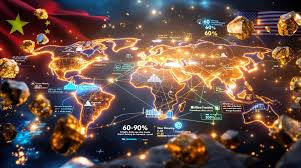
The 21st century is marked by the energy transition—a global turn away from fossil fuel and toward electric vehicles (EVs), renewable energy storage, and high-tech manufacturing. But this new revolution has created a new strategic battleground: dominance of key minerals like lithium, cobalt, nickel, and rare earths.
The rising phenomenon of Resource Nationalism captures nations with such limited, valuable reserves employing export controls, nationalization, and strategic taxation to secure enormous geopolitical and economic victories. It’s the new resource war, and the field of play is global supply chain domination and economic sovereignty.
Geopolitics of the Electric Battery
For decades, the global economy worried about the price of oil. Today, everyone’s concern is the price and security of the minerals that go into the electric battery.
Lithium and Cobalt: Both are key inputs to almost all modern lithium-ion batteries. Countries blessed with these resources, such as Chile, Argentina (lithium), and the Democratic Republic of Congo (cobalt), now wield massive power over the global automotive and electronics industry.
The Power Shift: Unlike oil, which is widely supplied and freely traded, the central mineral supply chain is heavily concentrated. China may not be producing the majority of the world’s cobalt, for instance, but it controls the vast majority of the world’s refining and processing capacity. This is a strategic vulnerability in Western economies.
This concentration provides mineral-rich nations with the leverage to make much greater-than-proportional demands upon other regions of the world.
The Resource Nationalist Toolkit
Resource nationalism is the practice of asserting control over natural resources inside a country’s borders. It’s the economic equivalent of walling off the perimeter of a valuable factory.
A number of significant tools are being employed by countries to assert this control:
Nationalization and State Ownership: Where the state owns mining assets completely or in the majority, typically full ownership being forced on foreign firms to sell holdings to SOEs. This places the state in complete control of production level, price, and allocation of raw materials.
Example: Certain South American nations have taken greater control of their massive lithium reserves, with an aim to process the material domestically rather than exporting raw brine.
Export Controls and Quotas: Through limiting the quantity of raw materials that may be exported, nations can restrict global supply, driving price up and forcing foreign buyers to negotiate on less desirable terms. This also serves to force foreign companies to set up in-country processing facilities.
Local Processing Requirements: The ideal course of action is to shift from the exportation of cheap raw materials to exporting expensive manufactured products. Countries are increasingly demanding that foreign miners process minerals locally before export. It keeps more value for the domestic economy by creating local employment, developing technical expertise, and raising industrial output.
Taxation and Royalties: Governments collect greater taxes and royalty rates for mining activities. Although it is mainly a tool for generating revenue, it is also a regulatory tool, incentivizing companies that adopt local development objectives and punishing those that fail to do so.
The Economic and Geopolitical Advantage
The leveraging of strategic minerals through resource nationalism provides double advantages:
Economic Advantage: Value Capture
By requiring local processing, nations rise up the value chain. Instead of earning a small margin on raw ore, they earn larger margins on processed metals or chemical stuff to be used in batteries. This redirects billions of dollars’ worth of economic activity away from consuming nations (like the US, Germany, or Japan) and into producing nations. The funds are reinvested in domestic social services and infrastructure.
Geopolitical Advantage: Leverage
Supply chain management gives manufacturing nations tremendous leverage during trade negotiations and international diplomacy. When global demand for EVs is booming, any nation that can control the supply tap becomes an all-powerful veto on industrial strategy of consuming nations. It can be used to extract concessions in anything from trade agreements to political support.
The rise of resource nationalism in strategic minerals is a re-alignment of world economic power that has far-reaching implications. For the world of consumption, it is straightforward: invest heavily in diversified supply chains, recycling facilities, and local processing to minimize the risks of dependency.