
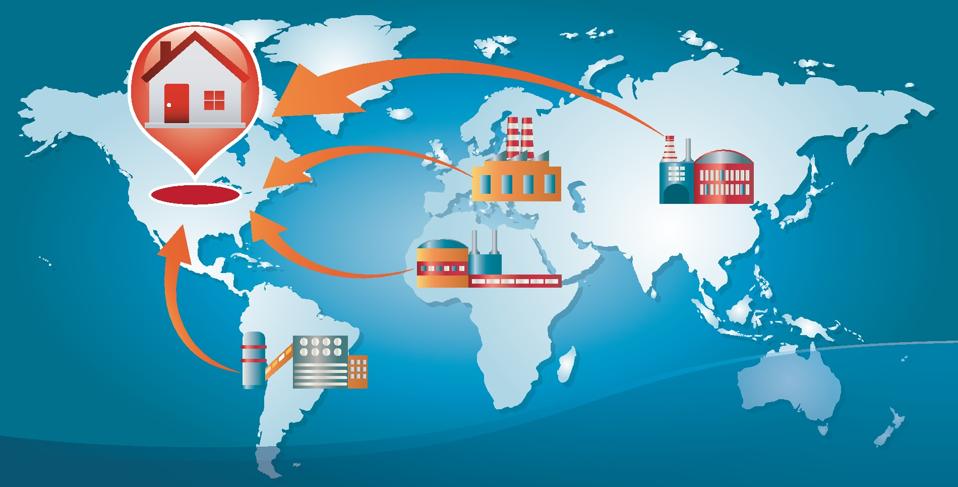
Global business used to live by one ruthless rule: cheap, fast, now. We chased components to the cheapest corner of the globe, building supply chains that stretched across seven seas just to save a few cents. But after years of trade wars, geopolitical chaos, and pandemic panic, that era is over. The new mantra isn’t cost; it’s resilience.
Companies are currently making one of the biggest strategic pivots in a generation, yanking production back home (re-shoring) or moving it to friendly neighbors (near-shoring).This isn’t just an operational shift; it’s a massive financial reckoning. Firms are fundamentally trading the old risk of catastrophic delay for a new certainty: significantly higher capital costs.
We need to look at this beyond the moving truck fees—it’s a deep redesign of the company’s financial DNA.
The Balance Sheet Makeover: Investing in Bricks and Mortar
The decision to re-shore is, first and foremost, a colossal Capital Expenditure (CapEx) decision. Think of it like this: you’ve decided to stop using cheap, leased global properties and instead buy and build a massive, permanent, high-tech headquarters in your hometown.
The New Mortgage (Debt and Equity)
Building that new, often automated domestic factory costs a bomb. Companies can’t just pay cash; they need a huge new mortgage (debt) or have to sell more shares (equity). This immediately jacks up their leverage.
While higher debt usually signals higher financial risk, investors are generally willing to tolerate it today. They view the CapEx not as reckless spending, but as a necessary strategic investment in long-term stability and market access.
The company’s assets also change hands: they shift from being vague contracts and invisible inventory to concrete, owned property (PP&E). That heavy machinery is excellent collateral for lenders, potentially getting the company a better rate on its debt. The flip side? If the strategy fails, you can’t sell a half-built factory quickly—it’s an illiquid financial anchor.
Government’s Helping Hand
Thankfully, the CapEx burden is often eased by state or federal programs (like the US CHIPS Act).These government subsidies are essentially free, non-dilutive financing. They cushion the blow of that massive upfront investment, providing a crucial boost to the project’s financial viability and making the whole move much more palatable on paper.
The Inventory Diet: Trading Safety Stock for Cash
One of the most immediate financial upsides of near-shoring is felt directly in the working capital—the cash required for a company’s daily survival.
No More Panic Piles
When a supply chain spans oceans, companies must keep massive “panic piles” of safety stock in warehouses. This stock is insurance against a ship delay, a port closure, or a geopolitical flare-up. That inventory is nothing more than cash trapped on a shelf.
When production moves closer, lead times shrink from months to weeks. The company can drastically reduce its inventory cushion, effectively freeing up millions in trapped cash. This turbo-charges the Cash Conversion Cycle (CCC), making the firm more liquid and operationally efficient.
The Cost Trade-Off
The downside is simple: while you hold less volume of stock, the cost per unit of that stock inevitably rises (thanks to higher domestic wages and utility bills). The finance team must precisely calculate whether the massive savings from running a leaner inventory outweigh the structural increase in the Cost of Goods Sold (COGS).
The Resilience Premium: What is Stability Worth?
The ultimate financial scorecard is the Weighted Average Cost of Capital (WACC)—the total interest rate the company pays for all its funding (debt and equity).
Re-shoring is intended to lower this, primarily by reducing risk:
- The Cost of Equity ($R_e$) Drops: Geopolitical risk and supply chain chaos make investors nervous. By insulating itself from these threats, the company becomes more predictable. Investors reward predictability by accepting a lower required return on their investment, effectively lowering the Cost of Equity. This is the “Resilience Premium” in action.
- Debt Stability ($R_d$) Balances: Yes, the firm takes on more debt for the new factories. But because those new facilities provide excellent collateral and the supply chain is less likely to break, lenders view the business as fundamentally more stable. This stability helps to mitigate the increased risk from higher leverage.
Ultimately, re-shoring is an expensive insurance policy that trades a clear, historical advantage (low COGS) for a critical, future-focused one (stable revenue). The successful finance team understands that paying a higher operating cost today is justifiable if it guarantees the ability to deliver product and earn predictable, stable revenue tomorrow.