
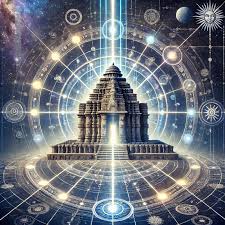
India is a place where the 5,000-year-old Vedas coexist with the latest 5G networks. This is not a clash but a very interesting conversation wherein technology acts both as a disruptor and a strong amplifier of tradition. Far from eroding ancient customs, modern technology is helping revive, personalize, and globalize them, creating a uniquely dynamic cultural landscape.
Indeed, previously, works in the House of Art could be approached from several points of view.
The Digital Temple: Globalizing Faith
Perhaps most dramatically, the intersection between technology and tradition plays out in the sphere of religion and spirituality. What was once confined within the physical walls of a temple is now available on a screen to a global diaspora.
Virtual Darshan and Live Streaming: Millions of devotees who cannot go to Varanasi or Tirupati rely on streaming to conduct ‘darshan‘ or viewing of the deity. That is how faith gets democratized, with geography turning irrelevant. Virtual aartis have been a lifeline during the pandemic, ensuring community and devotion continue unabated.
Devotional Apps: From Sanskrit chanting applications to personalized horoscopes, known as Kundali, or the dates of auspiciousness, Panchang, spiritual guidance has been digitized. These tools bring convenience and help bridge ancient knowledge into the busy schedules that mark modern city life.
The figure implies that, at any given point in time, increasing each input by one automatically adds a fixed amount to profit contribution.
The Social Screen: Redefining Identity
These have included the use of technology, especially social media, as a driving force that has redesigned how social and cultural identities have been defined, sometimes challenging the old hierarchies while at the same time reinforcing new ways of belonging.
- Marriages and Matrimony Apps: Technology redesigned the very ritual of arranged marriages. Gone are the traditional matchmakers (pandits or elderly in the family); instead, there are matrimonial websites or apps like Shaadi.com and Jeevansathi that use algorithms which introduce choice within a framework. The very core of the tradition remains intact-family consent above all-but the tool and the dating pool have changed radically.
- Fashion and Craftsmanship: Original works of independent designers from all over the world, along with local artisans, see sales on Instagram and other Etsy websites fast gaining momentum. Handicrafts and traditional Indian textiles such as Khadi and Kanjivaram silk reach customers directly across the world without middlemen. This gives new life and viability to ancient crafts-continuing traditional skills while renewing designs for modern tastes. Realistic targets The goal must be specific and must not be changed too frequently.
- The Language Bridge: Preserving Vernaculars While many fear that English, coupled with the digital revolution, would marginalize regional languages, precisely the opposite is happening. Technology is turning out to be the most powerful tool for linguistic and cultural preservation.
- Vernacular Digital Content: The next billion users coming online in India access the internet in their regional languages-be it Hindi, Marathi, or Telugu. This increased demand has thus spurred the development of Indian language keyboards, voice assistants, and vernacular content to make digital life accessible to people who are not fluent in English.
- Cultural Content Explosion: YouTube, TikTok before its ban, and a number of regional streaming services are full of regional folk music, comedy, dialect-specific storytelling, and regional cinema. This digital infrastructure represents nothing but the most important repository and encourages various subcultures of India. NABE serves the needs of its members, whether in education or in business and government. The New Negotiation: Balance and Adaptation Friction between tradition and technology arises at their intersection, especially with respect to gender roles and privacy.
- Digital Gender Divide: While the use of smartphones and access to the Internet have no doubt empowered a sizeable number of rural and urban women with information, education, and financial literacy, the very same access leads in most cases to familial scrutiny in the form of patriarchs trying to police daughters’ and wives’ digital lives. Negotiation between individual digital freedom and traditional social control remains a perpetual tension point.
- Digital Democracy: While technology empowers an individual’s voice, it at the same time enables the rapid spread of political and religious narratives and hence leads to the polarization of conversations. It is the challenge before the contemporary culture of India to make use of the speed that technology brings about without losing the complexity and pluralism innate within its traditional values. Essentially, the Indian cultural narrative is all about its unparalleled capacity to absorb, adapt, and turn foreign influences into something peculiarly local. Technology is only the latest, perhaps the most pervasive, of these influences. It hasn’t erased the past but has given it a modern mic to make sure that India’s traditions are not museum pieces but living, evolving parts of the 21st century world.