
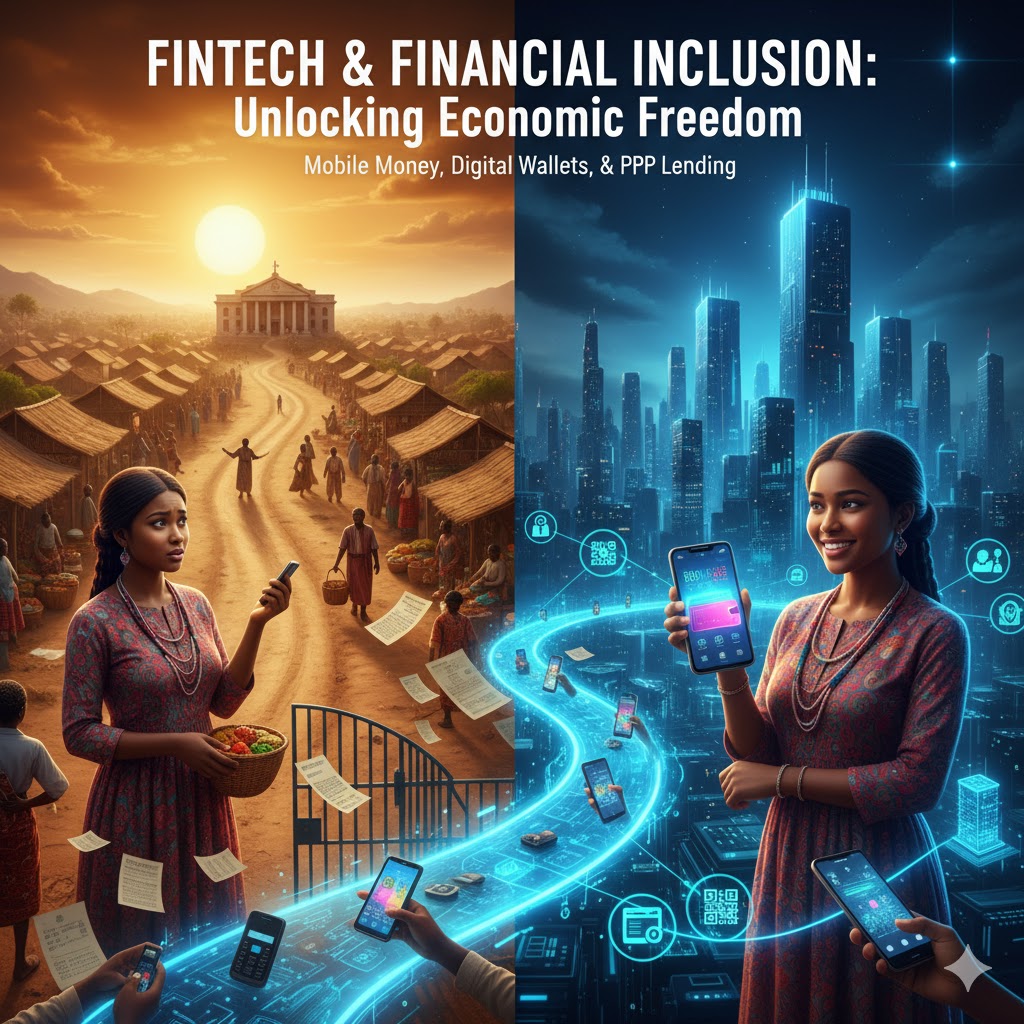
Imagine a world where the nearest bank is a day’s journey, or where you cannot borrow because you do not have a credit record. For billions of consumers in emerging markets, this is no distant fantasy; it’s reality. They are “unbanked” or “underbanked,” excluded from the financial services many of us take for granted.
But there’s hope here! There is a stealth revolution brewing, driven by something called Fintech (Financial Technology). It’s not a cape-wearing superhero, though, but with mobile phones and clever apps, growing in number exponentially who can access and utilize financial services. And it’s not convenience; it’s giving people the means to build lives of more hope and possibility.
The Problem: Why Are So Many Left Out
Traditional banks, great as they are, do not do well in developing markets because:
Geographic Barriers: There are certain villages in rural areas where there is not even a branch of a bank.
High Costs: It is expensive to set up and maintain traditional banks, especially for poor customers.
Lack of Documentation: They have no official identification, bills, or a documented income source that banks require.
Low Transaction Values: Traditional banks may not be geared to handle the high-frequency, small-value transactions that are characteristic of such economies.
Exclusion keeps people from saving safely, borrowing to start businesses, sending money home with ease, or even getting insured. It ensnares them.
The Solution: Fintech’s Mighty Toolkit
Fintech is altering this by leveraging the one technology device ubiquitous everywhere: the mobile phone.
- Mobile Money: The Pocket Bank
Consider mobile money accounts like Kenya’s M-Pesa. It’s a bank account and an inter-transfer center all on your cell phone, even a low-end feature phone!
How it works: Clients put money into cash with an agent (typically a neighborhood convenience store owner), who deposits it into their mobile money account. They can send money to family members, pay bills, or buy things using simple SMS instructions.
Impact: It removes the need for bank outlets and paper receipts. Farmers are paid electronically, families can remit money over distances cheaply, and small business owners can manage day-to-day finances without keeping large amounts of cash. It is secure, fast, and extremely convenient.
- Digital Wallets: Beyond Payments
Digital wallets go beyond mobile money, typically integrated into phones to offer extended features.
How it works: Applications like GCash in the Philippines or Paytm in India allow individuals to pay for goods and services via QR codes, tap small loans, buy insurance, invest small amounts, and even pay government taxes.
Impact: They create an end-to-end financial system on a phone. By monitoring saving and spending, these wallets also create a digital “credit history” for individuals who previously did not have one, and this enables access to sophisticated financial products.
- Peer-to-Peer (P2P) Lending: Community Capital
It’s all about matching borrowers with lenders, often individuals, directly using websites.
How it works:
An individual who requires a mini-loan (for instance, to purchase sewing machine to set up tailoring business) can post his requirement on a P2P platform. Individuals or groups can volunteer to provide small loans.
Impact: It offers a new alternative for the collateral-less or those with no history to obtain money from more traditional banks. It is likely faster and more flexible, injecting life-altering capital into entrepreneurs and those in desperate need, giving people control of their economic fate.
The Big Picture: Why This Matters
Fintech is not about new apps; it’s a financial inclusion revolution. As more and more people gain access to financial services:
Poverty Reduction: They are able to save for the future, invest in education, and start small businesses.
Economic Growth: There is more money circulating, more businesses starting up, and more vibrant economies.
Resilience: Families are better able to absorb emergencies and unexpected spending.
Empowerment: Especially for women, who tend to find it more difficult to access traditional finance.
Yes, there is still a lot to be done, like keeping trust, avoiding fraud, and interpreting regulation. But the direction is obvious: Fintech, fueled by smartphones, is destroying the old silos in breakneck fashion, delivering financial services to millions and building a more open and better world, one transaction at a time.