
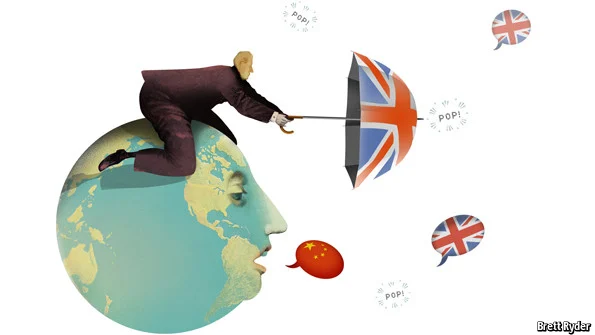
Have you ever searched for a recent paper, only to discover that the most pertinent papers are published only in English? Or noticed the latest technology buzzwords—from “deep learning” to “Fintech”—are almost invariably Anglophone developments? It is not necessarily one of convenience; it is an imponderable intellectual and cultural power known as the Global Language Divide, whereby the dominance of English education, technology, and business has created a sinister but pervasive system of cultural hegemony.
It’s a world where access to the global stage so often requires dominance of a single given language, in which rich scholarship and multiple perspectives are lost in translation.
The Academic Gatekeeper
In the global higher education and scientific research community, English is the uncontested lingua franca. It exercises a monstrous, sometimes unfair, hegemony over non-Anglophone researchers
- Publish or Perish, en inglés: En su búsqueda de prestigio, dinero, o estabilidad laboral, los académicos de cualquier parte del mundo deben publicar sus trabajos en journals prestigiosos, en inglés. El sistema convierte la publicación en el idioma materno en riesgo para la carrera laboral.
- Burden of Translation: Lacking fluency in English, other speakers must invest enormous resources and time in learning English writing cultural conventions, identify professional translators, or be rejected due to linguistic mistakes despite having paradigmatic research. It places non-Anglophone institutions at a competitive disadvantage and hinders knowledge sharing.
- Missing Knowledge: Vast amounts of worthwhile scientific and humanistic scholarship—particularly on local history, ethnography, and regional policy—are trapped behind linguistic national borders. This produces a one-sided world dataset dominated by anglophone preconceptions and questions.
The result is a system that serves already English-aware individuals, regardless of the type of home language scholarship one does, thereby reproducing the scholarly center of power in English-speaking nations.
The Technological Tidal Wave
The technology sector, particularly software, programming, and artificial intelligence, essentially operates only in English as a foundation language.
- Code and Documentation: Software documentation, computer programming languages, commercial standards, and community forums are predominantly English. While AI translators are learning at a pace never before seen, the foundation knowledge base is Anglophone.
- Cultural Production: The biggest cultural exports—once Anglophone-originated Hollywood film, international pop music, streaming services, and social media sites—are originally produced from Anglophone countries or swiftly localized to English, shaping global trends and cultural standards. This makes it difficult for unique non-Anglophone cultural goods to receive such visibility without considerable localization.
- Shaping the Future: English words like “Cloud Computing,” “Blockchain,” and “Metaverse” come into being on the global stage and are simply taken up or transliterated by other languages. The quiet lexical hegemony impacts the way new technology is conceived and discussed globally.
This technological and cultural hegemony serves to make technological innovation run through an Anglophone filter, potentially precluding other, localized solutions to global problems.
Decrease in Linguistic Diversity
English supremacy induces a self-perpetuating cycle of cultural domination, whereby there are various obvious results:
- Brain Drain: The most intelligent non-Anglophone experts are lured to English-speaking organizations and universities for further career development, draining intellectual settings in their countries.
- Constrained Discourse: If the very best scientific and cultural examples are predominantly in English, other languages will lack the specialist vocabulary required for modern scientific, technical, or philosophical argumentation, potentially limiting advanced thinking in such languages.
- Unbalanced Access: Numerous people in the developing world are being denied quality web-based learning (MOOCs), principal technical manuals, and solid global news sources on grounds of English inability, increasing economic imbalances.
The test is not to cut English loose—its role as a world binder is too worth it—but to acknowledge its work and exertion toward language balance mechanisms. Squandered in high-end, AI-powered translation programs, underwriting multilingual publishing websites, and accrediting home-language scholarship as an equal endeavor are first steps toward ensuring the global market of ideas as varied and fair.