
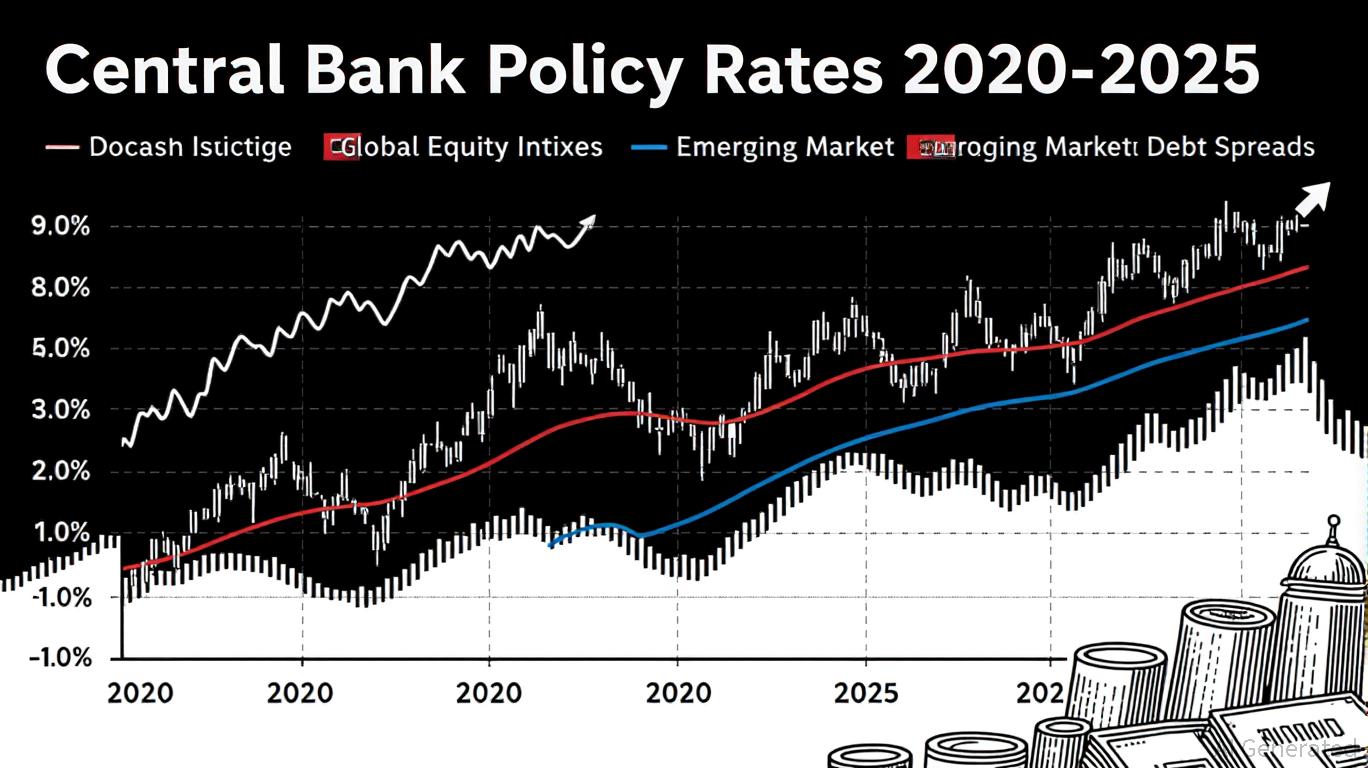
Central bank interest rate policy decision remains one of the strongest factors across global financial markets in 2025. Large economies on varying policy tracks due to different inflation and growth patterns ensured that the impacts on currency levels and equity markets were extensive and intricate.
Central Banks and Interest Rate Trends in 2025
The central bank interest rate decisions in 2025 were very different. The U.S. Federal Reserve moved cautiously, maintaining the rates constant at 4.00%-4.25% for the year as it signaled 1-2 lower rate reductions towards the end of the year when the inflation pressures somewhat moderated. On the other hand, the European Central Bank lowered rates from 3.00% to 2.50% at the beginning of the year in an attempt to spur growth, and it weakened the euro to a considerable extent. The Bank of Japan surprised markets by hiking interest rates for the first time in 17 years, and it surprised with the yen for a brief period of time. The Bank of England adopted a more middle-of-the-road strategy with some rate reductions and subsequently standstill.
International Currency Market Impact:
Alternative 2025 central bank agendas allowed alternative currency market directions. Steep U.S. interest rates compared to other economies followed resumed dollar strength as foreign capital flowed in to benefit from yield notwithstanding continued geopolitical and economic uncertainty. The euro, weighed down by ECB rate cuts and weak growth expectations, plummeted against the dollar, impacting multinationals’ profitability and trade balances. The unexpected appreciation of the Japanese yen triggered a deluge of capital flows, pushing it briefly above before settling back.
Interest rate differentials propelled carry trades, whereby investors short-sold high-yielding currencies and borrowed low-yielding currencies, and heightened currency volatility. Emerging market currencies were still susceptible to the same, weakening against the dollar on capital outflows.
Effects on Equity Markets
Interest rate trends affect equity markets most directly by affecting business borrowing and discounting future profits by investors. Relatively high but stabilizing U.S. rates in 2025 contributed to a stock market wherein strong growth of business profits assisted prices to achieve record highs, albeit under first-half volatility. Expected Fed reductions also buoyed investor sentiment.
On the other hand, European stock markets were restrained by rate reductions driven by economic uncertainty and registered modest gains. Increased rates tightened price-to-earnings multiples, strangling valuations in rate-sensitive sectors like utilities and property. Growth stocks and tech stocks were uneven in their performance, engineered to counter-move higher rates since they are tied to estimated earnings estimates.
2025 central bank rate actions were framed by ongoing efforts at balancing fighting inflation with stimulating economic growth. With loosening in a few of the larger economies continuing to leave inflation weak, modest loosening would be stimulative. Supply chain dislocations and global tensions continued to leave markets cautious about sharp policy reversals, though.
Both policymakers and investors watched intently as market performance was influenced by rate change expectation and thereby economics news like inflation and labor market trends.
Conclusion
Central bank interest rate changes have been the overarching driver of world currency and equity markets during 2025. Differential policy stances between the Federal Reserve, ECB, Bank of Japan, and other central banks introduced changing and sometimes conflictive financial conditions. Interest rate changes and their response in markets are a matter of concern for investors, corporates, and policymakers faced with the new world economy.
This paper highlights interest rate notification policy actions by the central bank, currency market reactions, and stock market responses in 2025 to demonstrate the maturity of global finance linkages.